
Case Study
Building a Medical Event Platform in 30 Days While Requirements Kept Evolving
Dr. Noor, Managing Head of a medical college, needed a complete event platform — passes, workshops, meals, cart, payments, and admin — in roughly thirty days. Requirements kept shifting throughout build, including a second event added near the end. The platform delivered on schedule; the architecture supported continued expansion after the event was postponed.
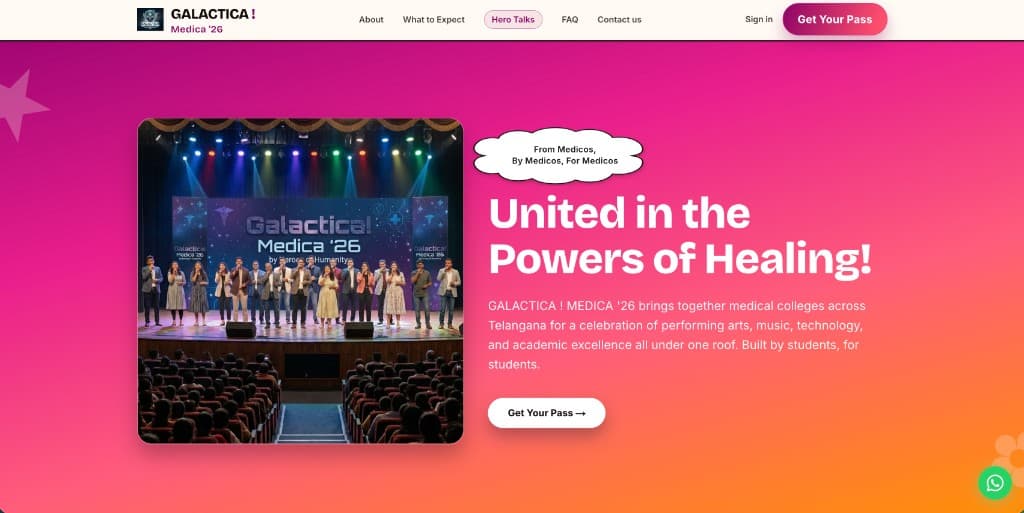
The attendee's first impression
The marketing homepage established the event brand immediately — clear positioning, pass purchase entry point, and navigation to event details without sending visitors into registration prematurely.
Project Overview
Project Overview
Dr. Noor approached me to build the digital infrastructure for an upcoming medical college event. The platform needed to support event information, pass purchases, workshop registration, meal selection, a shopping cart, online payments, an admin dashboard, and registration management — all within an approximately thirty-day delivery window. The product launched as Fiesta Liva and was later renamed Galactica. It sits within the Heroes of Humanity ecosystem — alongside Splice and Academy — as the digital platform for the Galactica festival, including events such as Medgala.
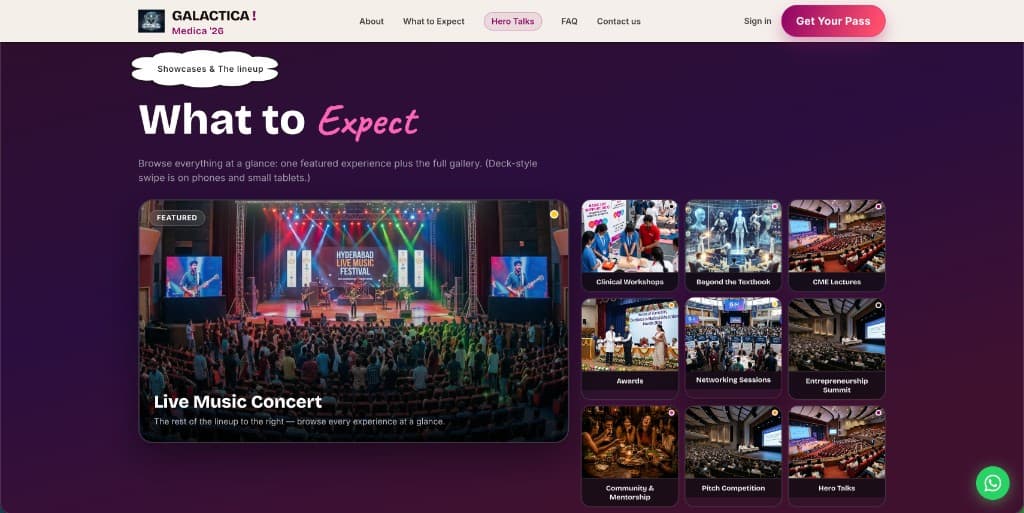
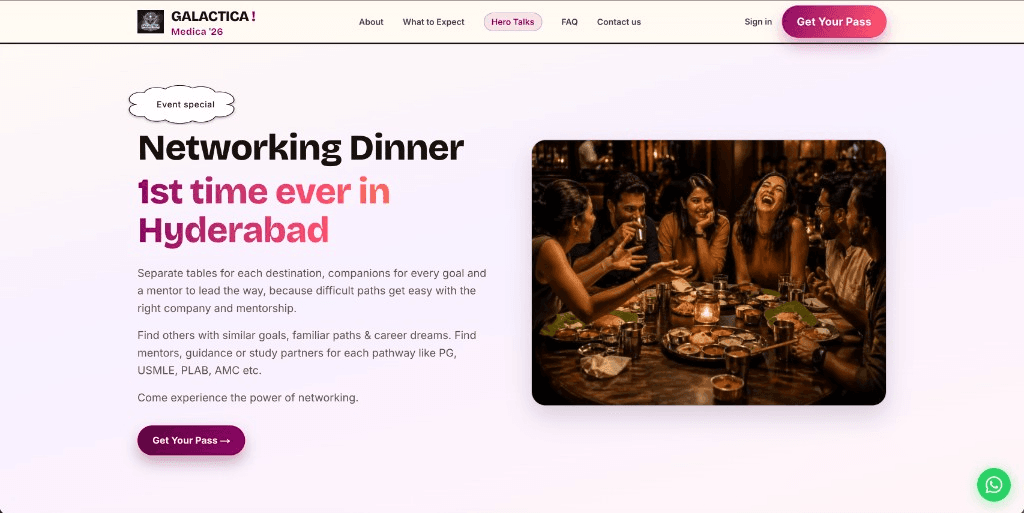
Event information at a glance
Workshops, lectures, and signature events were presented through a categorized grid and dedicated feature sections — giving attendees context before they entered the registration flow.
My Role
My Role
Sole Engineer — responsible for architecture, implementation, deployment, and production readiness. AI-assisted development tools (Cursor and Claude) accelerated delivery; all engineering decisions, architecture, testing, and production ownership remained mine.
The Challenge
The Challenge
The hardest constraint was not the stack or the timeline — it was scope that would not stay still. Feature requests arrived continuously: custom landing page animations, new registration flows, meal and workshop selection logic, and — near the end of development — Medgala, a specialized networking event within Galactica that needed its own registration surface on the same platform. Each addition had to ship without destabilizing what was already in production.
Constraints
Constraints
Roughly thirty days from kickoff to production-ready delivery. Single engineer on implementation. Requirements changed throughout development — there was no stable specification to build against. The client needed something operational, not a prototype that would be rebuilt after the event.
The Decision
The Decision
Treat the product as one deployable with explicit domain boundaries, not a collection of pages built feature-by-feature. Separate marketing, registration, and admin concerns at the routing layer so new event surfaces (like Medgala within Galactica) could be added without rewriting the core registration and payment flow. Build the payment path to work with payments enabled or disabled, so registration could ship before payment credentials were final. Automate deployment from the first week so every change reached a production-like environment without manual steps.
Implementation Approach
Implementation Approach
Prioritized decisions that would survive scope change: modular boundaries inside a single deployable, a registration and payment flow isolated from marketing presentation, and deployment automated early so every increment was verifiable in a production-like environment. Performance mattered because marketing pages carried custom animations and the registration flow had to remain responsive under load. Dashboard analytics and admin workflows were first-class from the start — not bolted on after launch.
Marketing, registration, and admin each lived behind distinct routing boundaries, which allowed Medgala — an event within Galactica — to receive a dedicated registration flow without disturbing the main festival pipeline. The payment flow was built production-ready — order creation, verification, and booking persistence — with a toggle to run registration-only when payments were not yet enabled. Admin tooling covered registration management, workshop seat claims, and operational analytics. Deployment ran through Docker with CI pushing to production on merge, removing manual release steps from an already compressed timeline. AI-assisted development tools (Cursor and Claude) accelerated implementation velocity. They did not replace engineering judgement — architecture, domain modelling, payment correctness, deployment configuration, and production readiness decisions remained deliberate and manual.
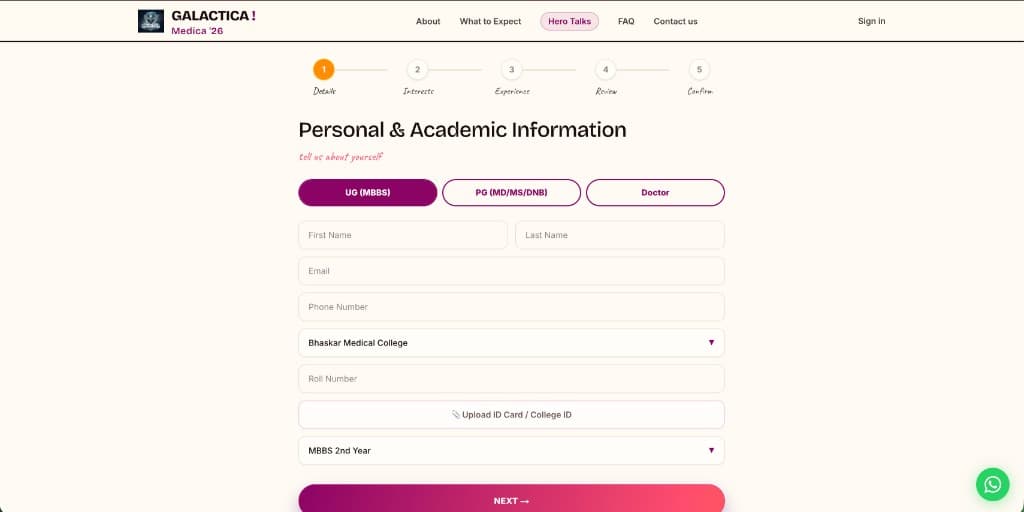
Registration broken into manageable steps
A five-step wizard collected personal, academic, and preference data progressively — keeping the form approachable despite the number of fields required for a medical college event.
Outcome
Outcome
The event was later postponed due to academic scheduling — outside the platform's control. The software itself delivered successfully: the client continued the engagement, requested additional features, and the architecture absorbed that expansion without a rewrite. Fiesta Liva was renamed Galactica; the platform now sits under Heroes of Humanity alongside Splice and Academy.
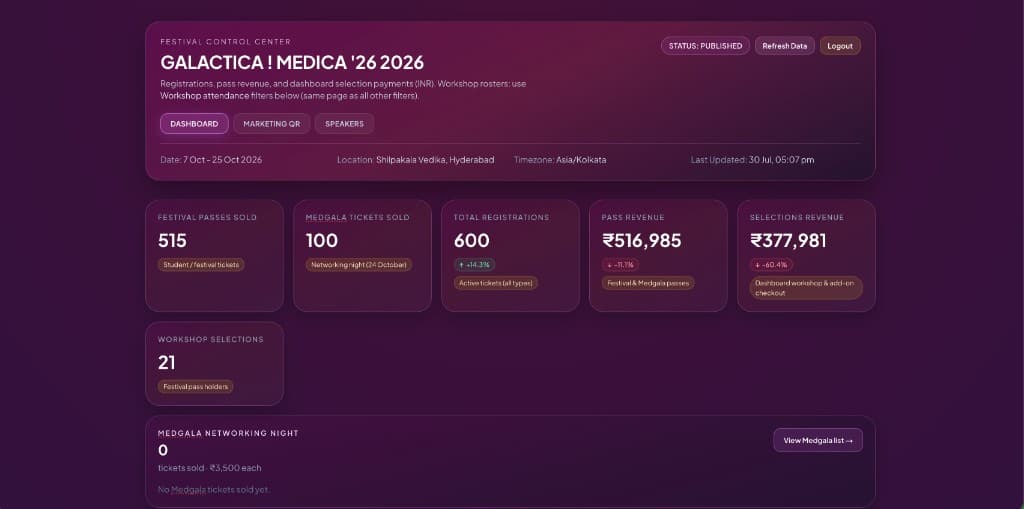
Organizers managed the full event from one control center
The admin dashboard surfaced festival pass sales, Medgala event tickets, total registrations, and revenue splits — giving Dr. Noor's team operational visibility without switching between tools.
Lessons Learned
Lessons Learned
When requirements change daily, the architecture must absorb change — not fight it. Boundaries between marketing, registration, and admin paid for themselves the first time Medgala arrived late in the cycle. Automating deployment early meant scope changes were always tested against something real, not just a local environment. AI tools are useful accelerators, but they do not remove the need for someone to own the system design.
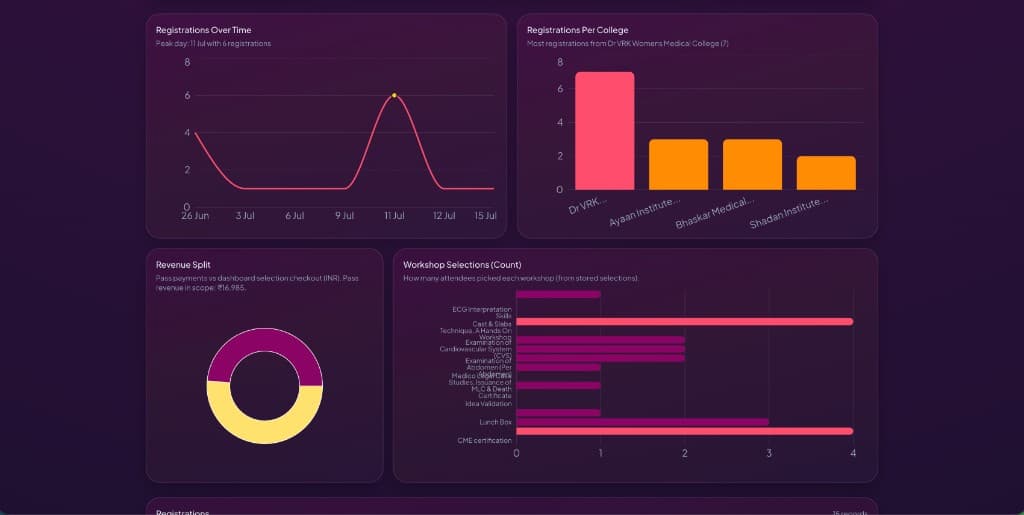
Operational insights informed event decisions
Registration trends, college-level breakdowns, revenue splits, and workshop popularity were available in real time — helping organizers understand demand patterns as requirements evolved.
What I'd Do Next
What I'd Do Next
Galactica continues under Heroes of Humanity alongside Splice and Academy. Shared infrastructure patterns across the ecosystem mean future initiatives can extend the same modular foundation rather than starting from scratch.